

Which Medicinal Herbs Are Used in Phytopharmaceuticals?


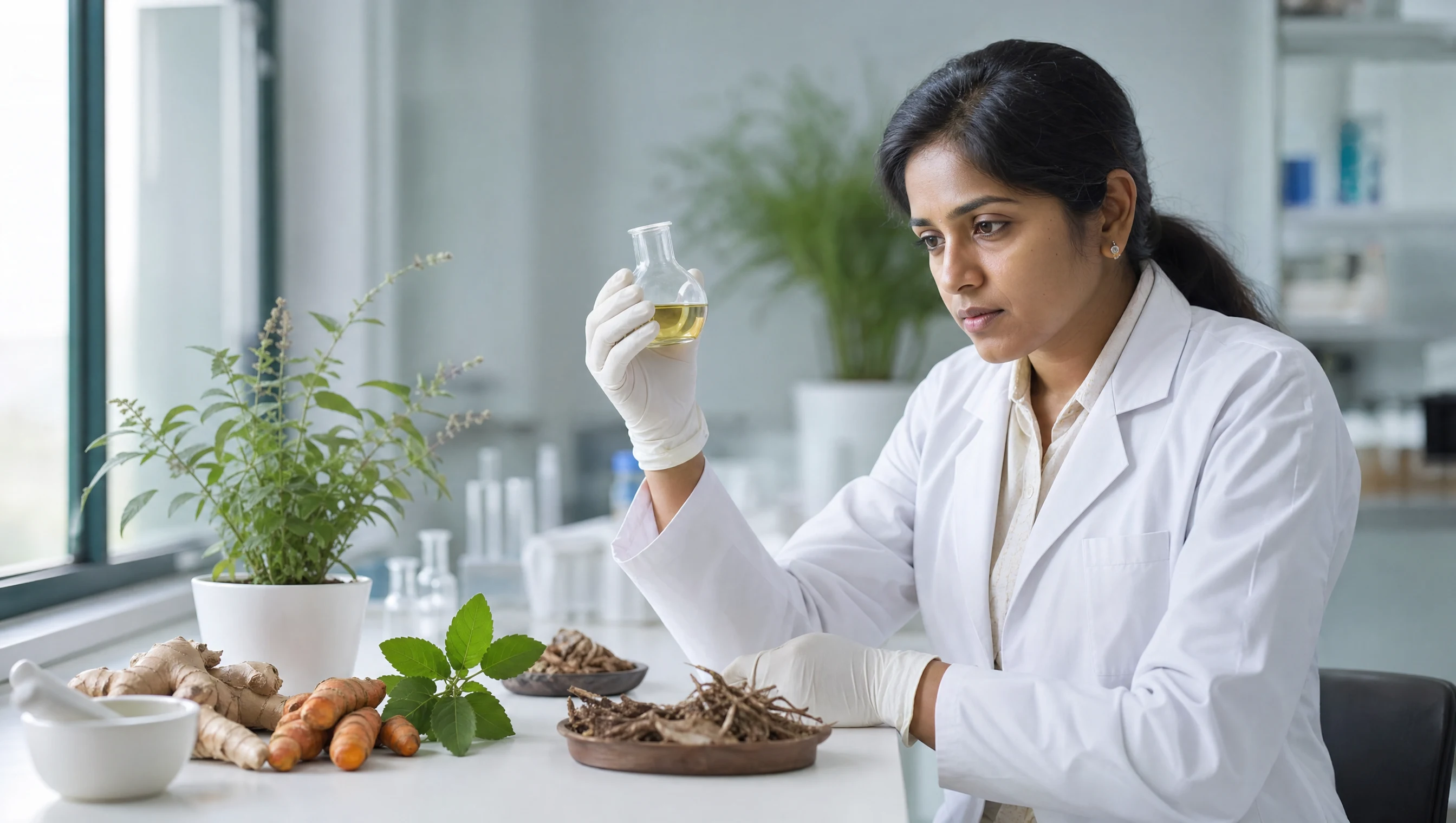
Medicinal plants have been used for millennia in traditional healthcare systems, including Ayurveda and Traditional Chinese Medicine. Traditional use provides valuable knowledge about plants and their possible health applications, but it does not by itself establish modern clinical efficacy, safety or pharmaceutical suitability.
Modern pharmaceutical research studies medicinal plants through a more systematic lens. Researchers identify potentially relevant constituents, investigate their biological activity and assess whether plant-derived materials can be developed into consistent, safe and scientifically evaluated preparations.
What is a plant-derived drug?
A plant-derived drug is a pharmaceutical product whose active substance or key therapeutic component originates from a plant, although its development and formulation may involve extensive pharmaceutical processing.
This is where phytopharmaceutical research contributes. It brings together botanical science, pharmacognosy, phytochemistry, pharmacology, pharmaceutical technology, analytical testing, toxicology and clinical research. The research may focus on an individual plant-derived compound, a chemically characterised extract, a standardised fraction or a finished botanical preparation. Not every research extract ultimately becomes an approved phytopharmaceutical drug.
How Are Herbal Medicines Different From Phytopharmaceuticals?
The terms medicinal herb, herbal medicine, herbal preparation and phytopharmaceutical drug are related, but they are not interchangeable.
A medicinal herb is a plant or plant material with traditional or scientifically investigated medicinal relevance. It may include a whole plant or a specific part, such as a root, leaf, flower, fruit, seed, bark, rhizome, resin or other plant exudate.
An herbal medicine may contain whole plants, plant parts, powders, extracts, oils or combinations of botanical ingredients. These products can have complex chemical compositions and their degree of standardisation, quality control and clinical evidence may vary according to the product and regulatory system.
The World Health Organisation provides guidance on the quality control, safety monitoring and evaluation of medicinal plant materials, herbal preparations and finished herbal products. This guidance does not mean that every traditional or herbal product has established clinical efficacy.
A phytopharmaceutical generally refers to a defined, characterised and standardised plant-derived pharmaceutical preparation. However, the term does not have one universal meaning worldwide. In India, “phytopharmaceutical drug” is a specific regulatory category.
The development of a defined plant-derived preparation may involve:
Botanical authentication: Confirming the identity of the source plant and the relevant plant part.
Controlled extraction or purification: Obtaining the intended extract, fraction or preparation under defined conditions.
Phytochemical characterisation: Identifying and measuring relevant constituents.
Standardisation: Establishing defined chemical and quality parameters for batch control.
Quality and stability testing: Assessing identity, purity, contaminants, consistency and stability.
Safety and efficacy evaluation: Generating appropriate pharmacological, toxicological, preclinical and clinical evidence.
The important distinction is therefore not simply plant-based versus synthetic. It is the application of appropriate pharmaceutical, analytical and regulatory standards to a defined and characterised plant-derived preparation.
A whole-herb preparation, crude extract and purified, standardised fraction obtained from the same plant should not automatically be considered equivalent. They may differ in chemical composition, pharmacological activity, bioavailability, safety and clinical evidence.
What Is the Regulatory Definition in India?
India introduced a specific regulatory category for phytopharmaceutical drugs in 2015 through G.S.R. 918(E). Under the Indian framework, a phytopharmaceutical drug includes a purified and standardised fraction of an extract of a medicinal plant or its part containing a defined minimum of four bioactive or phytochemical compounds assessed qualitatively and quantitatively. The definition covers specified internal or external uses in humans or animals and excludes parenteral administration.
The four-compound requirement is specific to this Indian regulatory definition and should not be assumed to apply internationally.
This definition explains why the presence of a medicinal herb or plant extract alone does not make a product a phytopharmaceutical drug. The specific preparation, botanical identity, extraction or purification process, composition, standardisation, quality, safety, efficacy and regulatory pathway all matter.
Indian regulatory and pharmacopoeial guidance also emphasises the need to identify and quantify defined compounds or other appropriate quality attributes in the preparation. In practice, the applicable requirements depend on the product and its intended regulatory classification.
What Types of Medicinal Plants Are Studied in Phytopharmaceutical Research?
There is no single exhaustive list of medicinal herbs used in phytopharmaceutical research. Hundreds of plants are investigated across pharmacognosy, phytochemistry, natural-product research, pharmaceutical development and clinical research.
Researchers may study the whole plant or specific parts, including:
Roots and rhizomes
Leaves and stems
Flowers and fruits
Seeds and bark
Wood and underground organs
Gums, resins, balsams and other plant exudates
Fixed oils and essential oils
The selected material depends on where the constituents of interest occur and whether the resulting preparation can be adequately identified, characterised, standardised and evaluated.
Turmeric (Curcuma longa): Studied for its curcuminoids, including curcumin, in phytochemical and pharmaceutical research.
Tulsi or holy basil (Ocimum tenuiflorum): Contains constituents such as eugenol, rosmarinic acid and ursolic acid and is studied in phytochemical and biological research.
Ginger (Zingiber officinale): Studied for gingerols, shogaols and related compounds in phytochemical and pharmacological research.
Ashwagandha (Withania somnifera): Known for its withanolides, which have been investigated in phytochemical and pharmacological research.
Boswellia (Boswellia serrata): Studied for boswellic acids, particularly in research involving resin chemistry and biological activity.
Guggul (Commiphora species): Contains guggulsterones and other resin constituents that have been investigated in resin chemistry and pharmacological research.
Bacopa (Bacopa monnieri): Studied for bacosides, a group of saponins, in phytochemical and biological research.
Centella (Centella asiatica): Contains triterpenoid constituents such as asiaticoside and madecassoside, studied for their biological properties.
Green tea (Camellia sinensis): Studied for its catechins, including EGCG, in polyphenol and natural-product research.
Ginseng (Panax species): Studied for ginsenosides in natural-product and pharmacological research.
Milk thistle (Silybum marianum): Studied for silymarin flavonolignans, including silybin, in botanical preparation and phytochemical research.
The chemical profile of a plant can vary according to its species, cultivar, chemotype, plant part, geographic origin, cultivation conditions, harvesting stage, processing method and extraction procedure. Therefore, the names in the table refer to representative constituents, not a complete or fixed chemical profile.
Which Constituents Occur in Medicinal Plants?
Medicinal plants contain chemically diverse constituents. Major groups investigated in pharmaceutical and pharmacognostic research include:
Alkaloids: Nitrogen-containing compounds that have provided important structures and leads for drug discovery.
Flavonoids and other polyphenols: Phenolic constituents that include flavonoids such as catechins, as well as phenolic acids and related compounds.
Terpenes and terpenoids: A broad group found in many medicinal and aromatic plants.
Saponins: Glycoside-containing compounds found in several medicinal species, including triterpenoid and steroidal saponins.
Phenolic compounds: A broad category that includes compounds investigated for antioxidant, anti-inflammatory and other biological activities.
Curcuminoids and related diarylheptanoids: Constituents characteristic of turmeric and studied for their biological properties.
Cannabinoids: Plant-derived constituents from Cannabis species investigated through defined composition, pharmacology, formulation, dosing, safety and clinical evaluation.
These categories can overlap because plant constituents may be classified according to different chemical systems. For example, catechins are flavonoids, while curcuminoids are diarylheptanoids rather than flavonoids.
A marker compound is not necessarily a therapeutically active compound. A marker may be selected because it is characteristic of a plant, sufficiently stable, measurable and useful for quality control. It may contribute to therapeutic activity, but this may not have been established. WHO guidance specifically notes that marker substances may or may not contribute to the therapeutic activity of a herbal preparation.
Identifying a potentially bioactive constituent is only an initial step. Its concentration, chemical stability, bioavailability, interactions, formulation and evidence for a specific preparation determine its pharmaceutical relevance.
How Are Plants Selected for Development?
Traditional use can provide a useful starting point, but it does not by itself establish pharmaceutical potential. Researchers may need to determine:
Whether the plant has been correctly identified.
Whether the correct species, variety or chemotype has been used.
Which plant part contains the relevant constituents.
Which constituents can be identified and measured reliably.
Whether there is evidence of relevant biological activity.
Whether the preparation can be produced consistently.
Whether adequate safety information is available.
Whether the preparation can be investigated in appropriate preclinical and clinical studies.
Whether the intended product can meet applicable regulatory requirements.
This screening helps distinguish a promising medicinal plant from one that can realistically be developed into a defined pharmaceutical preparation.
How Does Plant Material Become a Preparation?
The journey from plant material to a defined pharmaceutical preparation may involve several stages.
1. Source and authentication
The botanical identity, plant part, geographical source and quality of the starting material are established. Authentication may use macroscopic and microscopic examination, chemical methods and, where appropriate, DNA-based methods.
2. Extraction
The plant material is processed under controlled conditions. Solvent, temperature, extraction time, particle size and other parameters can influence the constituents recovered.
3. Fractionation or purification
Where required, the extract may be further processed to obtain a more defined fraction. The extent of purification depends on the intended preparation and regulatory pathway.
4. Chemical characterisation
Analytical techniques such as chromatography, spectroscopy and mass spectrometry may be used to identify and quantify relevant constituents and to generate a chemical fingerprint.
What is a chemical fingerprint in herbal research?A chemical fingerprint is a characteristic analytical profile of a plant preparation that helps identify it and assess consistency between batches.
5. Standardisation
Defined chemical and quality parameters are established so that batches can be compared and controlled. Standardisation may involve selected active constituents, marker compounds, chemical fingerprints and other measurable quality attributes.
6. Formulation and development
The preparation is developed into an appropriate dosage form. Researchers assess its stability, compatibility, release characteristics, quality and suitability for the intended route of administration.
The objective is to move from a variable biological starting material towards a reproducible and adequately characterised preparation.
Why Is Standardisation Important?
Plants are biological materials, so their chemical composition can naturally vary. Factors such as genetics, species, chemotype, geography, climate, cultivation, harvesting, plant maturity, processing, storage and extraction can influence the final chemical profile.
What is a chemotype in medicinal plants?
A chemotype is a chemically distinct variation within the same plant species, often differing in the types or amounts of constituents it produces.
Standardisation helps establish measurable characteristics that can be used to control this variability. It does not necessarily mean that every molecule in a complex botanical preparation has been identified or that all constituents are present in the same amount.
Quality assessment may include:
Botanical authentication
Macroscopic and microscopic examination
Chemical fingerprinting
Quantification of selected marker or bioactive compounds
Assessment of foreign matter
Microbial testing
Testing for heavy metals and other elemental contaminants
Testing for pesticide residues, mycotoxins and residual solvents where relevant
Assessment of adulteration and substitution
Stability testing
WHO provides internationally recognised methods and guidance for assessing the identity, purity and quality of medicinal plant materials, herbal materials and herbal products. These approaches also address potential contaminants and adulterants.
The goal is not to make every plant chemically identical. Rather, it is to establish quality parameters appropriate to the specific preparation and its intended use.
How Are Safety and Efficacy Evaluated?
Evidence about a plant does not automatically establish the safety or efficacy of every preparation made from it. Researchers must consider the specific preparation, composition, formulation, dose, route of administration, population and intended use.
Depending on the stage of development, research may examine:
Pharmacological activity
Proposed mechanisms of action
Pharmacokinetics and pharmacodynamics
Toxicology and safety
Stability and degradation products
Human tolerability
Herb-drug interactions
Clinical efficacy
What is pharmacokinetics and pharmacodynamics?
Pharmacokinetics describes how the body absorbs, distributes, metabolises and eliminates a drug or plant-derived constituent.
Pharmacodynamics examines how a drug or constituent interacts with the body and produces its biological effects.
“Natural” does not automatically mean safe. Herbal products may be associated with adverse effects, contamination, adulteration, variable dosing and interactions with medicines. Safety assessment is especially important for pregnant individuals, children, older adults and people with liver or kidney disease.
This is particularly relevant for complex botanical preparations because two extracts from the same plant may differ in their chemical composition. Evidence generated for one extract cannot automatically be transferred to another extract, a different plant part or a whole-herb product.
Why can the same medicinal plant produce different extracts?
Different solvents, temperatures, extraction times and processing conditions can recover different constituents, resulting in preparations with different chemical profiles.
Similarly, evidence from cell studies, animal experiments or isolated compounds cannot automatically be extrapolated to a finished herbal product in humans. Stronger clinical conclusions require studies of the specific preparation, dose, route and intended use.
What Role Do Plants Play in Drug Discovery?
Medicinal plants can contribute to drug discovery in several ways.
They may provide:
Individual compounds that become pharmaceutical drug candidates.
Chemical scaffolds for developing new molecules.
Standardised fractions for further investigation.
Complex extracts that generate leads for pharmacological research.
Bioactive constituents that guide formulation and therapeutic research.
Important plant-derived medicines have emerged through different routes. Some are purified single compounds, while others are modified derivatives or preparations based on plant chemistry. This means that “plant-derived” does not describe one uniform type of medicine.
Modern technologies are expanding this field further. Analytical chemistry, metabolomics, high-resolution chromatography, molecular biology, computational methods and advanced formulation technologies are helping researchers study complex plant chemistry in greater detail.
How Is Research Advancing Plant-Based Medicine?
The modern approach to medicinal plants is moving beyond simply asking, “Which plant is traditionally used?”
More specific questions include:
What does the plant material contain?
Which constituents may contribute to biological activity?
Can the preparation be consistently characterised?
How does the preparation behave in biological systems?
Can its quality, safety and efficacy be demonstrated?
Can it be manufactured and controlled reproducibly?
Does it meet the requirements of the relevant regulatory system?
This approach brings together botany, pharmacognosy, phytochemistry, pharmacology, analytical science, formulation development, toxicology and clinical research.
What is pharmacognosy?
Pharmacognosy is the study of medicines and biologically active substances obtained from natural sources, particularly medicinal plants.
The opportunity in plant-based pharmaceutical research lies in applying this scientific framework to medicinal plants while maintaining clear standards for identity, composition, quality, safety and evidence.
Conclusion
Medicinal plants remain an important source of compounds, extracts and research leads for plant-based pharmaceutical development. Traditional use provides valuable knowledge and may help guide research, but it does not by itself establish clinical efficacy or safety.
Modern phytopharmaceutical research helps identify potentially relevant constituents, characterise plant-derived preparations, control batch variability, investigate biological effects and evaluate safety and efficacy. A medicinal herb, crude extract, standardised fraction and approved phytopharmaceutical drug are not automatically equivalent.
As analytical, pharmacological and formulation technologies advance, medicinal plants may offer further opportunities for evidence-based plant-derived medicines. Those opportunities depend on rigorous botanical authentication, appropriate standardisation, quality control, safety assessment, clinical evaluation and compliance with the applicable regulatory framework.
Also watch:
Key Takeaways
- - Medicinal herbs contain diverse phytochemicals including alkaloids, flavonoids, terpenoids, polyphenols, saponins and cannabinoids.
- - A medicinal herb is not automatically a phytopharmaceutical drug. Development requires appropriate characterisation, standardisation, quality control and evidence.
- - Plant variability can affect composition and quality, from cultivation and harvesting to extraction and storage.
- - Standardisation helps improve consistency by establishing measurable chemical and quality parameters.
- - Modern phytopharmaceutical development combines traditional plant knowledge with pharmaceutical science, including analytical chemistry, pharmacology, formulation research, quality control and clinical evaluation.