

What Happens at Each Stage of Frozen Shoulder?



Frozen shoulders do not usually appear overnight. It follows a characteristic progression in which pain, stiffness and shoulder function change at different points. Understanding these stages can help explain why pain may improve while movement remains restricted, or why recovery can continue long after the worst pain has settled.
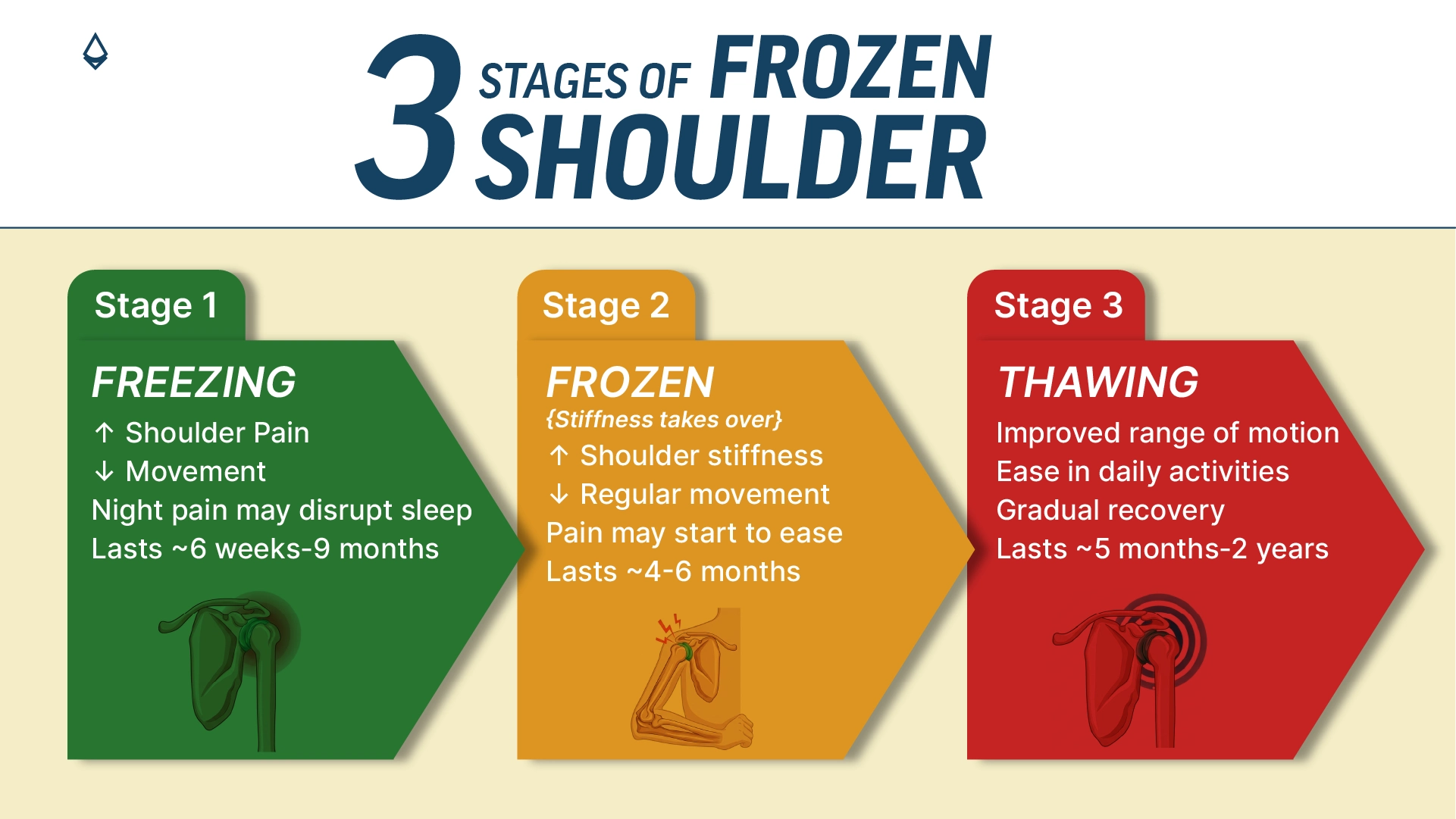
The condition typically moves through three stages: freezing, frozen and thawing. However, these stages overlap and their duration varies from person to person.
What happens during the freezing stage?
The freezing stage is generally the most painful phase. The shoulder gradually becomes more painful, particularly when reaching, rotating the arm or trying to sleep.
Can frozen shoulders affect sleep?
Yes, pain and difficulty finding a comfortable position can make sleep particularly difficult during the freezing stage.
What makes this stage distinctive is that pain and loss of movement progress together. As the shoulder becomes more painful, everyday activities may become increasingly restricted. Night pain can be particularly disruptive, making it difficult to find a comfortable sleeping position.
This phase can last approximately 6 weeks to 9 months.
What can movement look like during freezing stage?
Restrictions may first become noticeable during movements that require significant shoulder rotation, such as:
Reaching behind the back
Putting on or removing clothing
Reaching overhead
Combing or washing the hair
Reaching for objects placed behind the body
The important point is that the restriction tends to progress gradually, rather than appearing as a sudden loss of function.
Why does the frozen stage feel different?
The second stage can be confusing because pain may start to ease while the shoulder becomes even stiffer. This does not necessarily mean the condition has been resolved.
Instead, stiffness becomes the dominant problem. Activities that were possible with pain during the earlier phase may now be limited because the shoulder simply cannot move through its previous range.
The frozen stage commonly lasts around 4-6 months, although individual timelines vary.
For many people, this is the stage where functional limitations become particularly noticeable. Tasks may need to be modified, especially those involving overhead reaching or shoulder rotation.
What changes during the thawing stage?
The thawing stage marks the gradual return of mobility. Movement starts to improve and daily activities become easier as the shoulder progressively regains its range.
Recovery is usually incremental rather than sudden. One movement may improve before another and strength and confidence in using the arm can take additional time to return.
Can frozen shoulder return after recovery?
It can recur, although recurrence in the same shoulder is less common; the other shoulder may also be affected in some people.
The thawing phase can continue for approximately 5 months to 2 years.
A reduction in pain should therefore not be taken as the endpoint of recovery. Restoring useful movement is a separate part of the recovery process.
Can the recovery timeline be predicted exactly?
No. The three-stage model provides a framework, not a fixed calendar.
Some people move through the stages relatively quickly, while others experience prolonged stiffness. Recovery can also be influenced by factors such as the severity of movement restriction, underlying health conditions and how the shoulder is managed during recovery.
A useful way to think about progress is not simply “How many months have passed?”, but:
Is pain becoming less disruptive?
Is shoulder movement gradually increasing?
Are everyday activities becoming easier?
Is function improving over time?
Does less pain mean the frozen shoulder is healing?
Not necessarily; pain may decrease while stiffness remains or even becomes more noticeable during the frozen stage.
A recent randomised controlled trial found that patients with frozen shoulder improved significantly over 12 months with both watchful waiting and physical therapy, with no significant difference in patient-reported outcomes between the two groups.
Why can stiffness remain after the pain improves?
Pain and stiffness do not necessarily resolve at the same rate.
During the frozen stage, inflammatory pain may decrease while the shoulder capsule remains contracted. Consequently, someone may feel considerably less pain but still be unable to raise or rotate the arm normally.
What is a contracted shoulder capsule?
It refers to the tightening and shrinking of the tissue surrounding the shoulder joint, which contributes to restricted movement.
This is one reason why stopping rehabilitation as soon as pain improves may not reflect complete functional recovery. The focus gradually shifts from controlling symptoms to restoring movement and function.
What does progress during frozen shoulder recovery look like?
Recovery is often better measured through function rather than pain alone.
Practical signs of improvement may include being able to:
Reach a higher shelf
Put on a shirt more easily
Reach behind the head
Fasten clothing behind the back
Sleep more comfortably
Use the affected arm for longer periods
Small improvements in range of motion can be meaningful, particularly when the condition has caused substantial stiffness.
Is persistent stiffness a reason to seek reassessment?
Frozen shoulder can have a long natural course, but persistent shoulder symptoms should not automatically be attributed to adhesive capsulitis.
Reassessment may be appropriate when pain or stiffness is worsening rather than gradually improving, when function remains severely restricted, or when the pattern of symptoms changes. Other shoulder problems, including rotator cuff disorders and arthritis, can produce overlapping symptoms and may require different management.
Is frozen shoulder the same as a rotator cuff injury?
No; frozen shoulder mainly restricts shoulder-joint movement, while rotator cuff problems primarily involve the tendons that help move and stabilise the shoulder.
Can pain management support rehabilitation in frozen shoulder?
Managing pain can be important because severe discomfort may make it difficult to participate in movement-based rehabilitation. Treatment therefore often combines symptom control with strategies aimed at restoring function.
Cannabinoid-based medications are also being used as a part of broader pain-management approaches. Their potential role is mainly in symptom management and should be considered under appropriate healthcare supervision.
Also watch:
Key Takeaways
- - The stages are progressive, not fixed deadlines - freezing, frozen and thawing can vary considerably in duration.
- - Pain and stiffness behave differently - pain often peaks earlier, while restricted movement can remain prominent after pain decreases.
- - Recovery takes time - meaningful improvement may occur over months, with the thawing stage potentially lasting up to two years.
- - Function is an important measure of recovery: being able to perform everyday movements more comfortably can indicate meaningful progress.
- - Persistent symptoms deserve reassessment: a prolonged recovery can be normal, but worsening or atypical symptoms should be clinically reviewed.