

What Are the Best Exercises for Tennis Elbow Recovery?



Tennis Elbow is a quiet nightmare. It is not a dramatic injury, just a dull, nagging ache that ruins the small stuff. Lifting a coffee cup stings. Shaking hands makes one hesitate. Gripping a racket feels impossible. This condition, medically known as Lateral Epicondylitis, does not just affect performance on the court; it erodes confidence in everyday movement and total rest will not fix it. The key to real recovery is teaching that tendon to work again through targeted, deliberate movement.
Is Tennis Elbow and Golfers' Elbow Same?
No. While both conditions stem from repetitive forearm strain, the key difference comes down to location: tennis elbow strikes the outside of the joint, whereas golfer’s elbow targets the inside. Tennis elbow (lateral epicondylitis) inflames the outer tendons responsible for lifting the wrist and extending the fingers, frequently triggered by tennis backhands, typing, or lifting objects palms-down. Conversely, golfer’s elbow (medial epicondylitis) affects the inner tendons that handle wrist flexion and gripping power, usually caused by golf swings, pulling motions, or heavy carrying. In short, if pain flares along the outer elbow when bending the wrist backwards, it points to tennis elbow; if it aches along the inner elbow when clenching a fist, golfer’s elbow is the likely culprit.
Once outer-elbow pain is identified, recovery shifts toward rebuilding tendon strength through targeted, evidence-based exercises.
Why does total arm rest make Tennis Elbow worse?
Tendons need gentle, controlled movement to heal. Complete rest can make them weaker. Gradually increasing activity helps the tendon rebuild strength and recover.
What Are the Essential Exercises for Tennis Elbow?
1. Isometric Wrist Extension Hold
Reduces pain and builds wrist tolerance without movement.
Forearm on table, palm down, wrist over edge.
Press the back of a light fist upward against resistance.
Hold 10–30 seconds. Do 4-6 reps, 1-2 times daily.
2. Wrist Extensor Stretch
Improves flexibility along the top of the forearm.
Extend arm forward, palm down, elbow straight.
Use the other hand to pull the palm down and slightly inward.
Hold 15-30 seconds. Repeat 3-5 times, multiple times daily.
3. Eccentric Wrist Extension
Rebuilds tendon strength by lowering weight under control.
Forearm on a table, holding a light dumbbell.
Lift the weight with the non-injured hand, then lower it slowly (3-5 seconds) with the affected wrist.
3 sets of 10-15 reps, 1-2 times daily. Increase weight over time.
4. The Tyler Twist (FlexBar Eccentric Exercise)
Combines extension and rotation for targeted tendon loading.
Hold the rubber bar vertically (affected hand bottom, palm out; other hand top, palm in).
Extend arms forward, twist bar, and slowly let the affected wrist uncoil.
3 sets of 15 reps daily. Progress to stiffer resistance bars.
5. Concentric Wrist Extension
Builds lifting strength for later rehab stages.
Forearm on table holding a light weight.
Actively curl the weight upward over 2 seconds, then gently lower.
3 sets of 10-15 reps. Add weight as stability improves.
6. Grip Strengthening
Restores hand strength for daily holding and squeezing, tracking recovery progress.
Firmly squeeze a soft ball, putty, or gripper (or wring a towel) for 5-10 seconds.
Do 10-15 reps per session, increasing resistance as strength improves.
7. Forearm Rotation & Wrist Deviation Work
Builds rotational mobility and side-to-side wrist stability to support elbow function.
Hold the bottom of a light hammer or weight, then smoothly rotate palm-up/palm-down or tilt the wrist side-to-side.
Do 2-3 sets of 10-12 controlled reps in each direction.
8. Scapular & Rotator Cuff Control
Stabilises the shoulder blade to take strain off the elbow joint.
Perform band rows, wall slides, or shoulder blade squeezes - pulling blades down and back without shrugging.
Do 2-3 sets of 10-12 reps, 2-3 times a week.
9. Mobilisation With Movement (Mulligan Technique)
Relieves pain during movement under therapist supervision.
A physical therapist applies a gentle sideways glide to the elbow while one grips or moves.
Done over 6-8 clinical sessions alongside the home exercises.
10. Deep Transverse Friction Massage & Mills Manipulation
Clinician-led techniques to quickly calm localised tissue sensitivity.
Combines cross-fibre pressure on the tendon with a brief, targeted elbow extension stretch.
Used temporarily during acute flare-ups alongside active strengthening.
Is Pain During Exercise Normal for Tennis Elbow?
Yes, mild discomfort can be normal during recovery. Keep pain at 5/10 or less and make sure it settles back to one’s usual level by the next morning.
While mastering these individual exercises is vital, structuring them into a progressive timeline ensures recovery stays safe and effective over time.
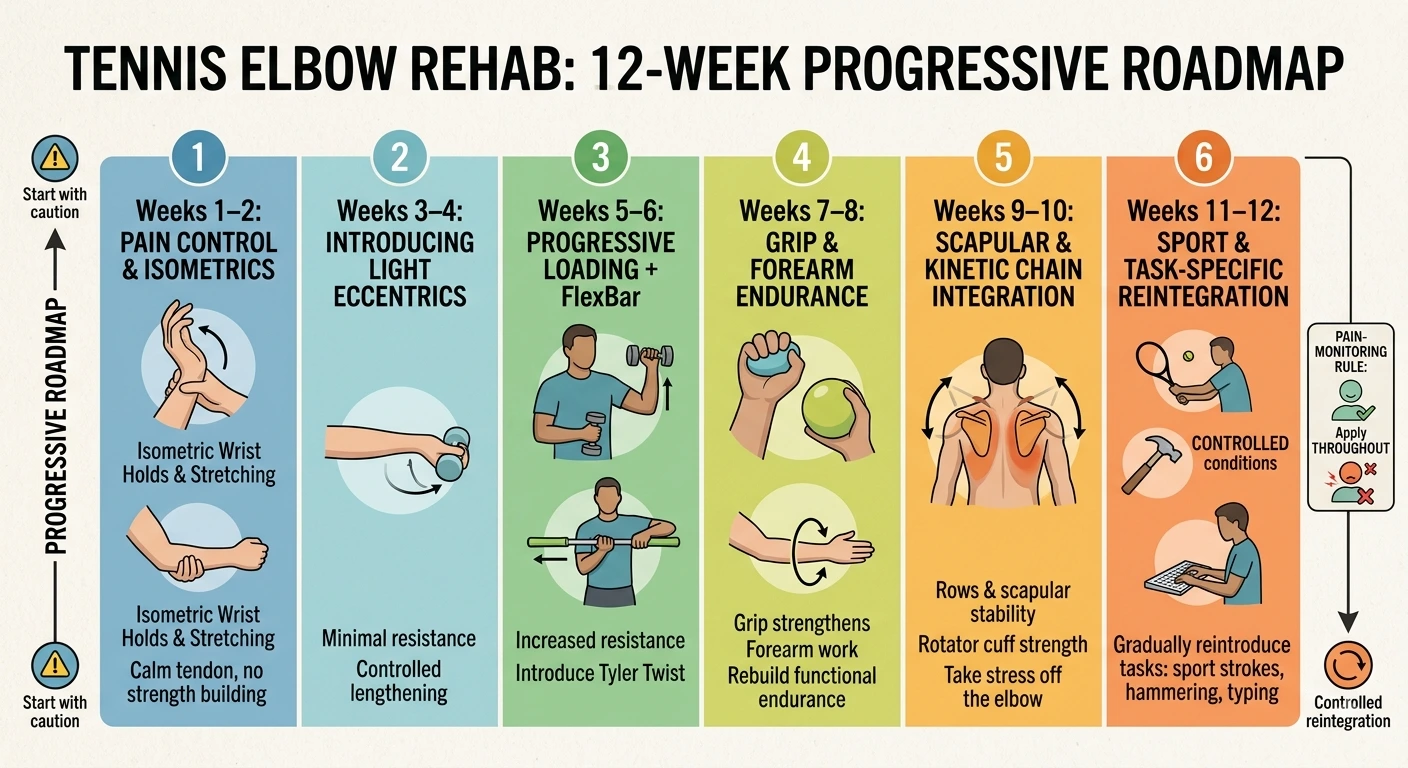
This roadmap is a general framework rather than a fixed prescription; progression should always be adjusted based on individual pain response and tissue tolerance, ideally under the guidance of a physical therapist.
Should a Counterforce Brace Be Worn During Rehabilitation?
A counterforce brace can provide short-term pain relief, especially during activities that strain the tendon. However, it should support, not replace, progressive rehabilitation exercises.
How to Begin Rehabilitation Journey?
Rehabilitating tennis elbow doesn’t mean throwing random fixes at the wall to see what sticks. Real recovery comes down to a targeted, three-part game plan:
Get a Precision Diagnosis: A physical therapist pinpoints the real cause, rules out nerve pain, and creates a customised strength plan.
Master the Home Protocol: Once one learns proper technique from a pro, simple home exercises become the primary engine for lasting relief.
Eliminate the Root Trigger: Adjusting daily habits, like desk setup, tool grip, or racket tension, removes constant strain and keeps one pain-free long-term.
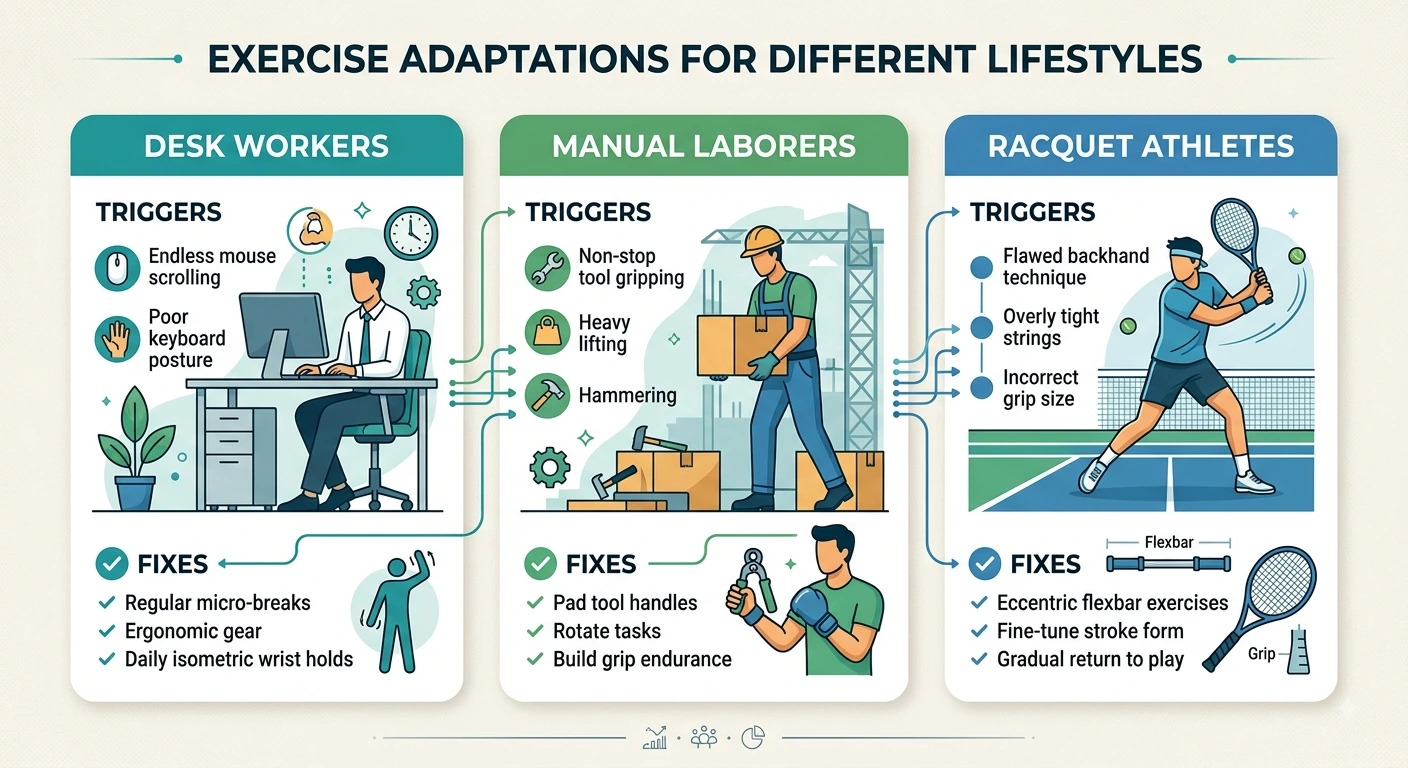
Recognising which category applies helps prioritise which exercises deserve the most attention early on.
Conclusion
Healing tennis elbow isn’t about just waiting and hoping it gets better. The real key is a simple, stepped exercise routine, building up from light holds to targeted twists and strengthening, to help the tendon recover properly without pushing past the pain limit.
To keep the ache manageable while rebuilding, supportive topicals can make a real difference. Many people use cannabinoid-based oils or gels directly on the spot to ease localised pain, offering a natural way to take the edge off alongside rest and movement tweaks. Just be sure to chat with a healthcare professional before adding any new topical to the routine, ensuring it works alongside the core rehab plan.
Key Takeaways
- - Active, structured exercise beats total rest whenever treating Tennis Elbow.
- - Clinical evidence heavily favours core movements like wrist extensions, grip strengthening and the iconic Tyler Twist.
- - Passive manual therapies like friction massage offer no additional proven benefit over dedicated exercise.
- - Mild to moderate pain during rehab is acceptable as long as it returns to baseline within a day.
- - Supplementary exercises often rely on practical clinical practice rather than solid trial data.