

What Are the Best Exercises for Plantar Fasciitis Pain Relief?


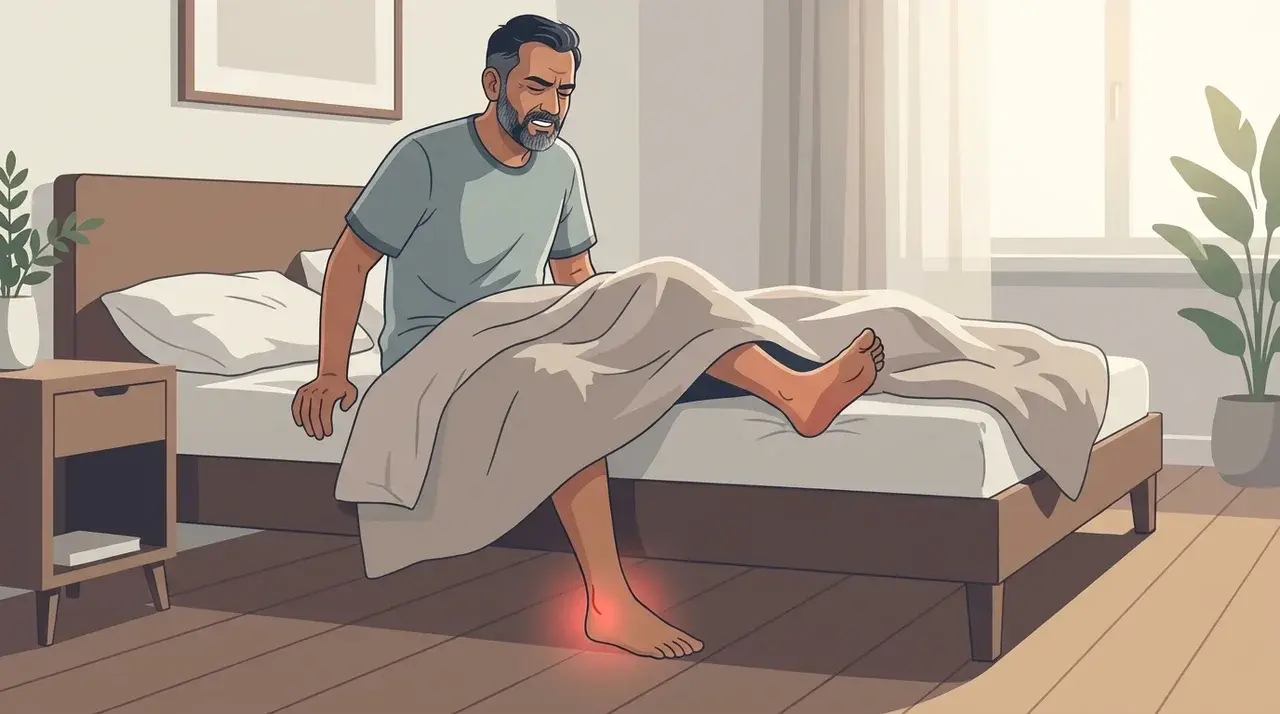
A sharp, stabbing pain with the first steps out of bed is the classic sign of plantar fasciitis. It occurs when the plantar fascia, the thick band of tissue running from the heel to the toes, becomes irritated and overloaded.
The best exercises for plantar fasciitis focus on relieving stiffness, improving flexibility and gradually strengthening the foot and calf. Plantar fascia-specific stretches, calf stretches and progressive heel raises can help reduce heel pain and improve the foot’s ability to handle daily activities. However, the right exercises and progression matter, especially when pain is worse with the first steps in the morning.
Understanding the typical pattern of plantar fasciitis also helps distinguish it from other common causes of heel pain.
How can I tell if my heel pain is actually plantar fasciitis?
If your sharpest heel pain happens during your very first steps in the morning or after sitting for a while, it is likely plantar fasciitis. The pain usually dulls into a subtle ache as you move around, but it can flare up again after intense activity.
What Distinguishes Different Types of Heel Pain?
Plantar Fasciitis: Pain at the bottom of the heel/arch, worst with first steps or after prolonged sitting.
Achilles Tendinopathy: Pain at the back of the heel, worsening with push-off.
Calcaneal Heel Spurs: Often an incidental imaging finding, surrounding soft-tissue inflammation, not the spur itself, typically drives the pain.
Can plantar fasciitis occur in both feet at the same time?
Yes. While it usually affects one foot, bilateral plantar fasciitis occurs in up to 30% of cases—often triggered by sudden weight changes, poor footwear, or long periods of standing on hard surfaces.
Once the type of heel pain is identified, the focus can shift to exercises that address the underlying tissue and restore its loading capacity.
What are the Best Exercises for Plantar Fasciitis Pain Relief?
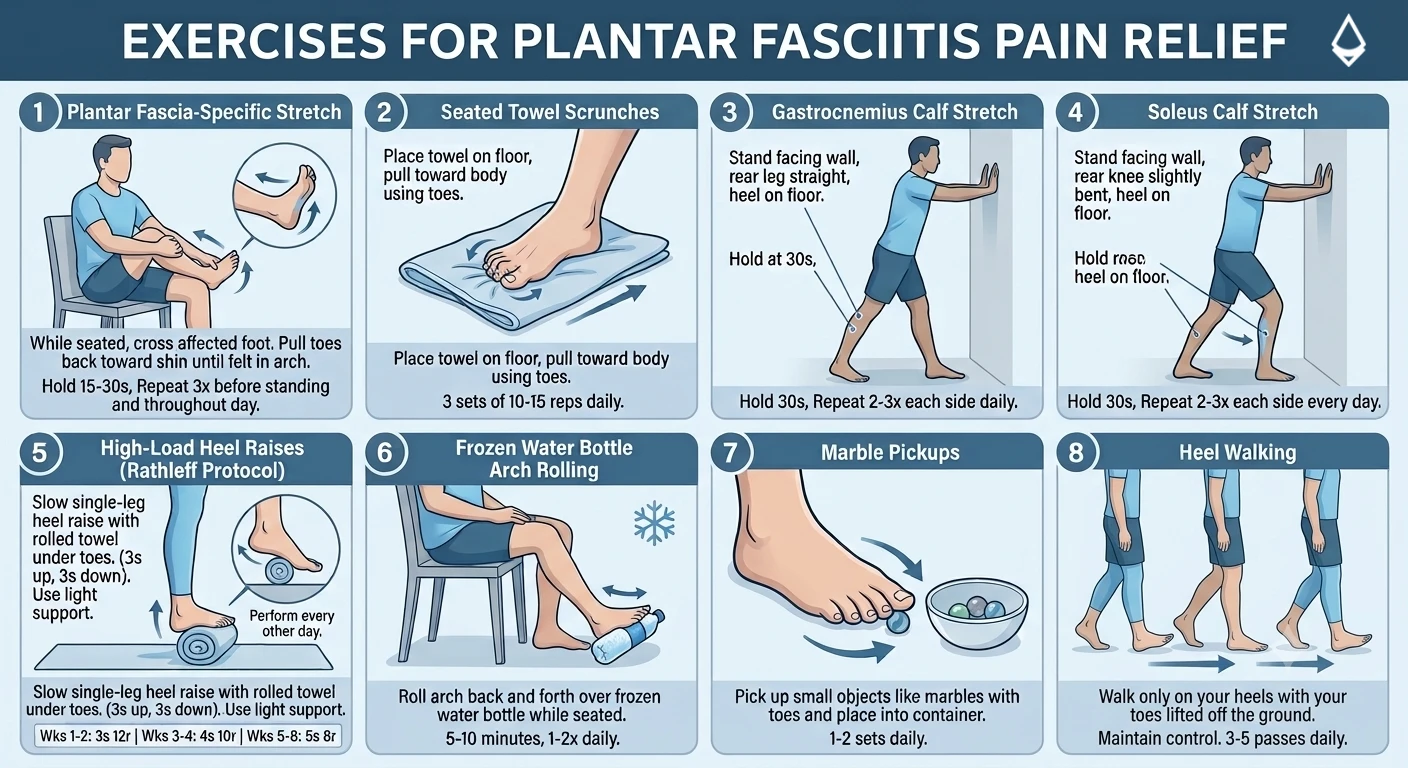
Plantar Fascia-Specific Stretch
Helps reduce stiffness and improve flexibility in the plantar fascia.
While seated, cross the affected foot over the opposite knee.
Gently pull the toes back toward the shin until a stretch is felt in the arch.
Hold for 15 to 30 seconds.
Repeat 3 times before standing each morning and 2 to 3 times throughout the day.
Seated Towel Scrunches
Helps strengthen the small muscles that support the arch.
While seated, place a towel flat on the floor.
Use the toes to pull the towel toward the body.
Perform 3 sets of 10 to 15 repetitions.
Complete once daily.
Gastrocnemius Calf Stretch
Helps relieve tightness in the larger calf muscle, reducing strain on the plantar fascia.
Stand facing a wall with one leg behind the other.
Keep the back knee straight and the heel firmly on the floor.
Lean forward until a stretch is felt in the calf.
Hold for 30 seconds and repeat 2 to 3 times on each side daily.
Soleus Calf Stretch
Targets the deeper calf muscle and helps improve ankle flexibility.
Stand in the same position as the gastrocnemius stretch.
Slightly bend the back knee while keeping the heel on the ground.
Lean forward until a stretch is felt in the lower calf.
Hold for 30 seconds and repeat 2 to 3 times on each side daily.
High-Load Heel Raises with Towel Roll (Rathleff Protocol)
Helps strengthen the foot and calf while promoting plantar fascia recovery.
Place a rolled towel under the toes to keep them slightly elevated.
Perform a slow single-leg heel raise, taking about 3 seconds to rise and 3 seconds to lower.
Use a wall or chair for balance if needed.
Perform every other day and progress as follows:
Weeks 1–2: 3 sets of 12 repetitions
Weeks 3–4: 4 sets of 10 repetitions
Weeks 5–8: 5 sets of 8 repetitions
Frozen Water Bottle Arch Rolling
Combines gentle massage with cold therapy and may help ease discomfort.
While seated, roll the arch of the foot back and forth over a frozen water bottle.
Continue for 5 to 10 minutes.
Perform once or twice daily.
Marble Pickups
Helps strengthen the small stabilising muscles of the foot.
Place several marbles or small objects on the floor.
Pick them up using the toes and place them into a container.
Perform 1 to 2 sets daily.
Heel Walking
Helps strengthen the muscles at the front of the lower leg while gently stretching the calves.
Walk short distances on the heels with the toes lifted off the floor.
Perform 3 to 5 passes daily.
Is mild pain during plantar fasciitis exercises normal?
Discomfort up to roughly 4-5 out of 10 is generally acceptable if it settles soon after exercise and next-morning pain returns to baseline rather than worsening. Rising morning pain signals the load should be reduced.
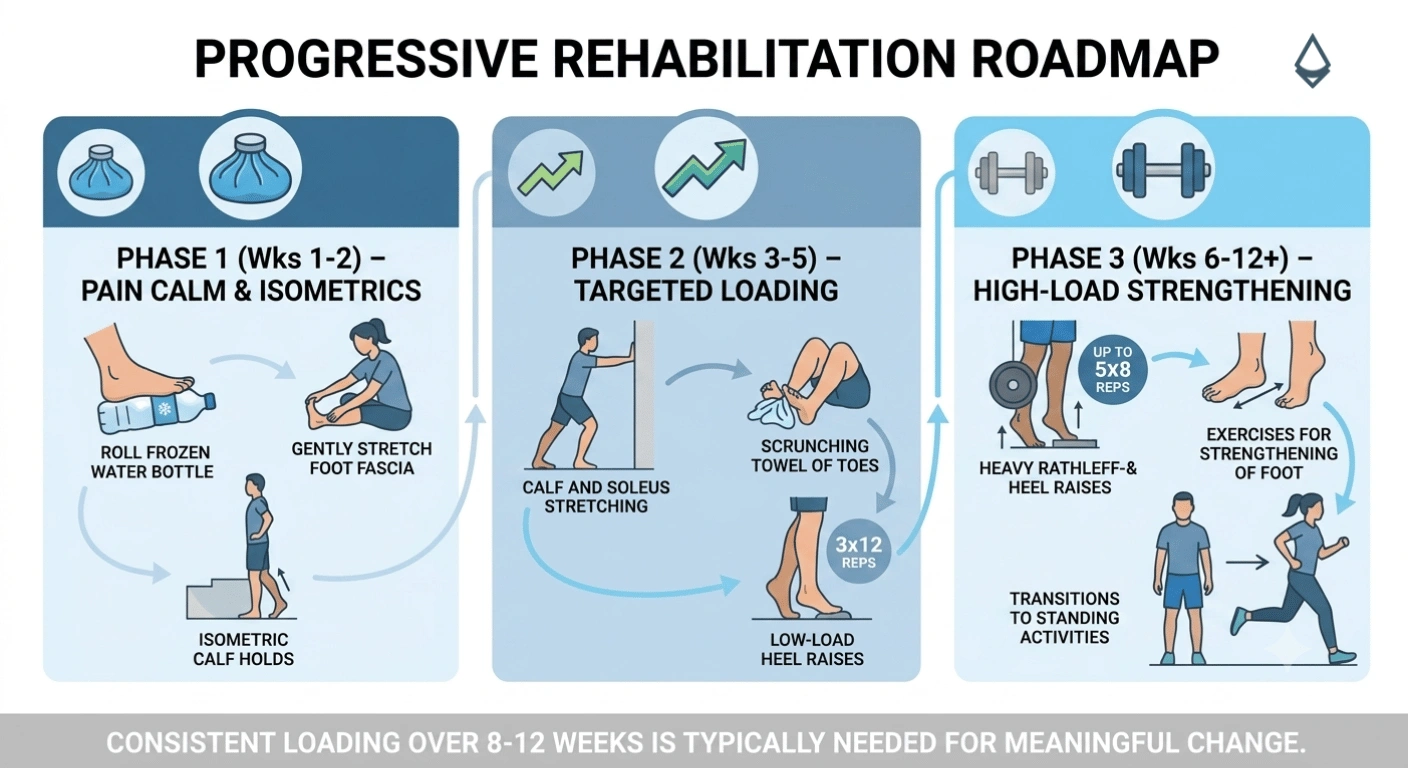
These exercises are most effective when progressed gradually, from pain control and mobility to targeted loading and strengthening.
Why does total foot rest fail to cure Plantar Fasciitis?
Connective tissue adapts to the load placed on it. Without mechanical stimulation, blood flow and collagen synthesis remain limited, so load tolerance never rebuilds. Graded loading, not immobilisation, drives repair.
Rehabilitation should also fit the demands of everyday life, as different activities place different stresses on the foot.
Lifestyle Adaptations
Runners: Stretch calves/fascia pre-run; place high-load heel raises on rest days.
Standing Workers: Supportive footwear plus mid-shift towel stretches offset cumulative loading.
Desk Workers: Counteract sitting-related shortening with seated scrunches and hourly ankle mobility.
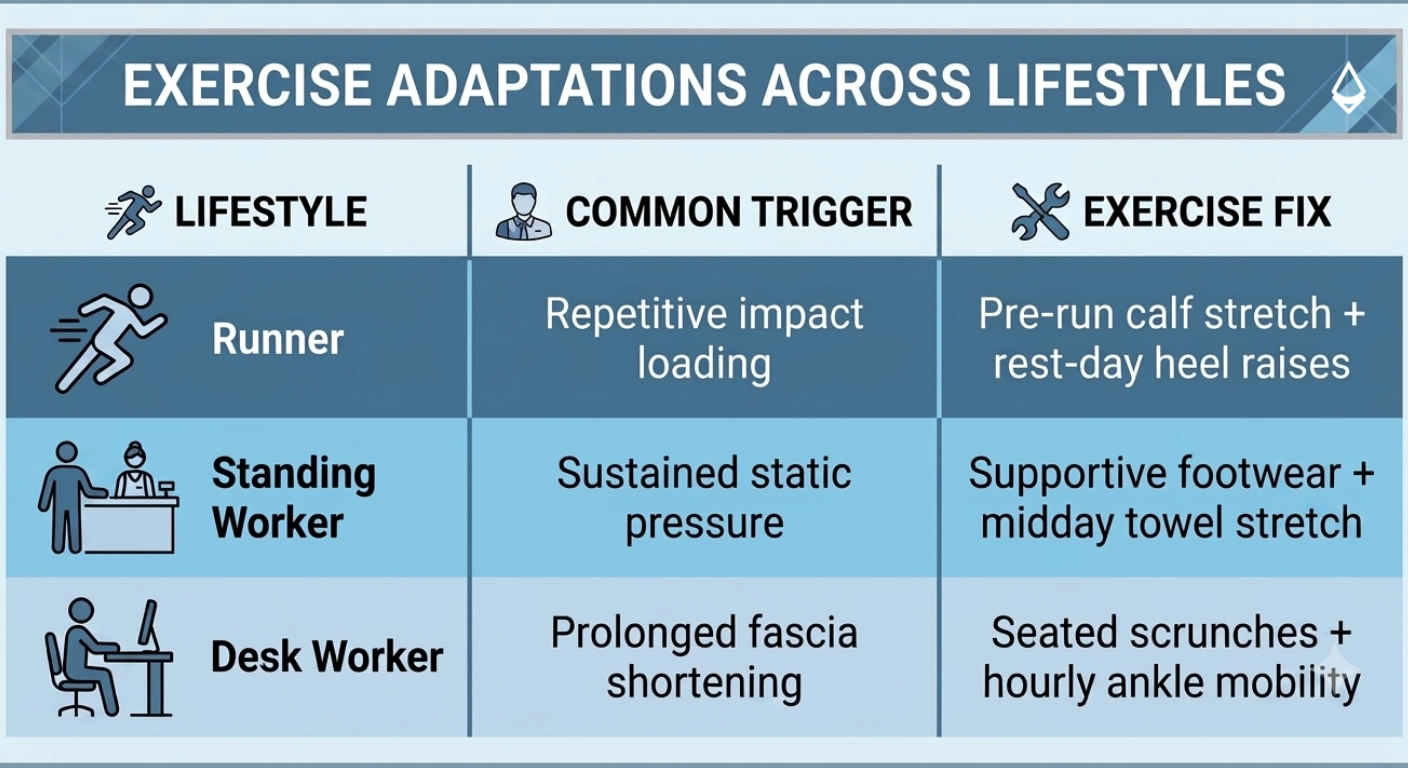
Rehabilitation should also fit the demands of everyday life, as different activities place different stresses on the foot. The following adjustments show how rehabilitation can be tailored to common daily routines.
Conclusion
Recovery from plantar fasciitis is best supported by gradual stretching and strengthening exercises rather than complete rest. Consistent loading helps the plantar fascia become stronger and better able to handle everyday activities. Supportive footwear and other comfort measures may help manage symptoms, but they work best when combined with an active rehabilitation program.
For additional symptom relief, some individuals use cannabinoid-based oils or topical formulations to help ease localised discomfort. These products may complement an exercise-based recovery plan, but they should not replace rehabilitation and are best used after consulting a healthcare professional.
Also watch:
Key Takeaways
- - Plantar fasciitis typically causes heel pain with the first few steps in the morning or after periods of rest.
- - Progressive loading through targeted stretches and strengthening exercises helps the plantar fascia heal and become more resilient.
- - Calf flexibility and foot strength play an important role in reducing strain on the plantar fascia and supporting recovery.
- - Mild discomfort during exercise is generally acceptable, but worsening morning pain may indicate that the load is too high.
- - Regular exercise, supportive footwear and gradual return to activity form the foundation of successful plantar fasciitis rehabilitation.